
What Is a Ghost Kitchen? Meaning, How It Works, Benefits, Challenges & Real Examples

Food delivery has transformed the restaurant industry over the past decade. Instead of dining at a physical restaurant, millions of customers now order meals through food delivery apps such as Uber Eats, DoorDash, and Grubhub. As consumer behavior has shifted toward convenience, a new restaurant business model has emerged: the ghost kitchen.
A ghost kitchen is a delivery-only food business that prepares meals for online orders without operating a traditional dining room. These commercial kitchens focus entirely on food production and delivery, allowing restaurant owners and food entrepreneurs to reduce costs while serving customers through digital ordering platforms.
The popularity of ghost kitchens has increased rapidly because they eliminate many of the expenses associated with traditional restaurants, including large dining spaces, front-of-house staff, and premium retail locations. This lower-cost approach makes it easier for businesses to launch new food concepts, test menus, and expand into new markets.
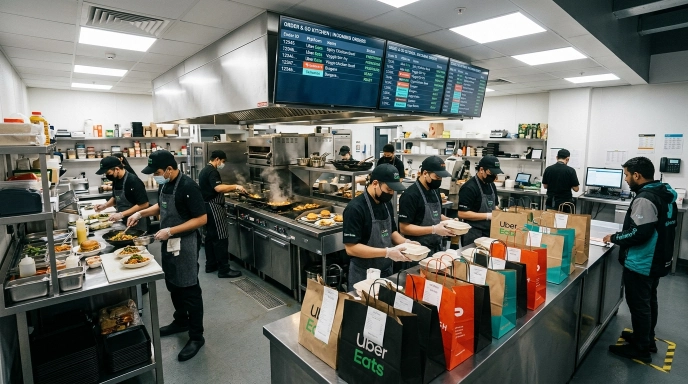
However, ghost kitchens are not simply cheaper versions of restaurants. They represent an entirely different operating model that prioritizes delivery efficiency, digital visibility, and customer convenience.
In this guide, you’ll learn exactly what a ghost kitchen is, how the business model works, the different types of ghost kitchens, their benefits and challenges, startup costs, profitability potential, legal requirements, and real-world examples. Whether you’re a curious customer, a restaurant owner, or an aspiring food entrepreneur, this article will help you understand why ghost kitchens have become one of the most talked-about innovations in the modern food service industry.
What Is a Ghost Kitchen? A Comprehensive Guide
A ghost kitchen is a commercial kitchen that prepares food exclusively for delivery and takeout orders. Unlike traditional restaurants, ghost kitchens do not have dining rooms, customer seating areas, or storefronts. Instead, customers place orders online through websites, mobile apps, or third-party delivery platforms, and the food is prepared in a dedicated kitchen before being delivered to their location.
Ghost kitchens are also commonly known as cloud kitchens, dark kitchens, delivery-only restaurants, or virtual kitchens. Their primary purpose is to reduce operating costs while maximizing efficiency for online food orders.
For example, a burger brand may operate entirely from a ghost kitchen without ever opening a physical restaurant. Customers discover the brand through delivery apps, place an order online, and receive their food just as they would from a traditional restaurant. The key difference is that the business operates behind the scenes without a public-facing dining space.
The ghost kitchen business model has become increasingly popular among restaurant owners, food startups, franchise operators, and entrepreneurs because it allows them to enter the food delivery market with significantly lower startup costs than opening a conventional restaurant.
Key Facts About Ghost Kitchens
- Operate without dine-in facilities.
- Focus primarily on food delivery and takeout.
- Use commercial kitchen spaces for food preparation.
- Often partner with delivery apps such as Uber Eats and DoorDash.
- Can operate one or multiple restaurant brands from a single location.
- Require less upfront investment than traditional restaurants.
- Are designed to optimize speed, efficiency, and delivery performance.
In simple terms, a ghost kitchen is a restaurant that exists online rather than on a busy street corner. Customers experience the food, but they never visit the kitchen itself.
Here you can read guide about the small apartment spring decor.
Ghost Kitchen Meaning Explained in Simple Terms
A ghost kitchen is a restaurant operation that serves customers without maintaining a traditional storefront or dining area. Instead of relying on walk-in traffic, the entire business focuses on preparing food for online orders placed through food delivery apps, websites, and mobile ordering platforms.
Think of a ghost kitchen as the “behind-the-scenes” part of a restaurant. Customers can browse the menu, place orders, pay online, and receive their food, but they never visit the actual kitchen. The business exists primarily in the digital world while the cooking happens in a commercial kitchen facility.
For example, when you order a burger through a delivery app, the restaurant brand you see may not have a physical dining room at all. The meal could be prepared inside a ghost kitchen that serves multiple delivery-only brands from the same location.
This model allows restaurant owners to focus on food quality, kitchen efficiency, and delivery performance instead of spending money on dining rooms, servers, furniture, and expensive retail locations.
Ghost Kitchen Definition at a Glance
A ghost kitchen is a delivery-only restaurant that operates from a commercial kitchen and serves customers through online ordering and food delivery platforms rather than through a physical dining space.
Key Characteristics of a Ghost Kitchen
- No dine-in customers
- No traditional storefront
- Delivery-focused operations
- Online ordering system
- Commercial kitchen facility
- Lower operating costs
- Digital-first business model
In simple terms, a ghost kitchen sells food just like a traditional restaurant, but it does so entirely through online channels.
Why Is It Called a Ghost Kitchen?
The term “ghost kitchen” comes from the fact that the restaurant is essentially invisible to the public. Customers can order food from the brand online, but they cannot see or visit the physical restaurant in the way they would with a traditional dining establishment.
Unlike a conventional restaurant with a visible location, signage, dining room, and customer-facing staff, a ghost kitchen operates quietly behind the scenes. To the customer, the restaurant appears online but has little or no physical presence.
This “invisible” nature is what inspired the name ghost kitchen.
Over time, several similar terms have emerged within the food service industry, including:
- Ghost Kitchen
- Cloud Kitchen
- Dark Kitchen
- Delivery-Only Kitchen
- Virtual Kitchen
While there can be slight differences depending on the business model, these terms are often used interchangeably to describe restaurants that primarily serve customers through online ordering and delivery services.
Why the Name Matters
The term highlights one of the biggest shifts in modern dining: customers no longer need to visit a restaurant to enjoy its food. As online food ordering continues to grow, restaurant brands can build successful businesses without relying on physical dining spaces.
In many ways, ghost kitchens represent the digital transformation of the restaurant industry.
How Does a Ghost Kitchen Work?
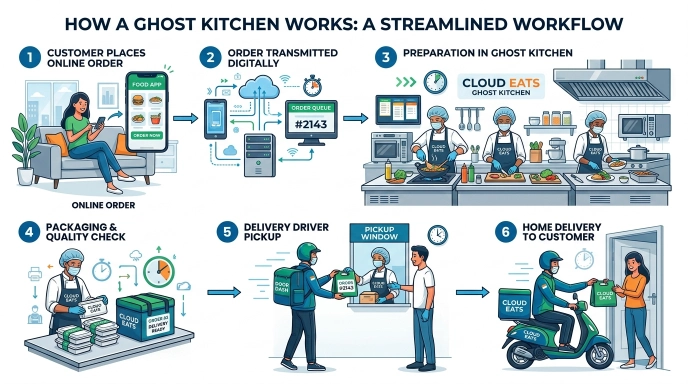
A ghost kitchen follows a streamlined process designed specifically for food delivery. Instead of managing dine-in customers, reservations, and front-of-house operations, the business focuses entirely on preparing and fulfilling online orders.
Although the process may appear simple, ghost kitchens rely on technology, logistics, delivery platforms, and efficient kitchen workflows to operate successfully.
Here’s a step-by-step breakdown of how a ghost kitchen works.
Here you can read kitchen decor ideas.
Step 1: Customers Order Online
The process begins when a customer places an order through a food delivery app, restaurant website, or online ordering platform.
Popular ordering channels include:
- Uber Eats
- DoorDash
- Grubhub
- Deliveroo
- Restaurant-owned websites
- Mobile ordering apps
The customer selects menu items, completes payment, and submits the order digitally.
Unlike traditional restaurants, there is no phone call, host stand, or dining room involved. Everything happens online.
Step 2: Orders Are Sent to the Kitchen
Once the order is placed, it is automatically transmitted to the ghost kitchen through a centralized order management system.
Modern ghost kitchens often use integrated software that combines orders from multiple delivery platforms into a single dashboard. This helps kitchen staff manage incoming orders efficiently and reduce mistakes.
The kitchen immediately receives information such as:
- Customer order details
- Preparation instructions
- Delivery requirements
- Pickup time estimates
This automated process improves speed and operational efficiency.
Step 3: Food Preparation Begins
Kitchen staff prepare the meal according to the order specifications.
Since ghost kitchens are designed specifically for delivery, menus are often optimized around foods that travel well and maintain quality during transportation.
Examples include:
- Burgers
- Pizza
- Sandwiches
- Rice bowls
- Fried chicken
- Pasta dishes
The food is cooked, assembled, packaged, and prepared for pickup while maintaining food safety and quality standards.
Many successful ghost kitchens use streamlined menus to improve consistency and reduce preparation times.
Step 4: Delivery Drivers Pick Up Orders
Once the order is ready, a delivery driver arrives at the kitchen facility to collect it.
Depending on the setup, drivers may work for:
- Uber Eats
- DoorDash
- Grubhub
- Third-party logistics companies
- Restaurant-owned delivery teams
The order is verified, handed to the driver, and prepared for transportation to the customer.
Efficient pickup systems are critical because delayed pickups can negatively affect food quality and customer satisfaction.
Step 5: Food Reaches the Customer
The final step occurs when the delivery driver transports the order to the customer’s location.
Customers receive their food in the same way they would from a traditional restaurant delivery service. However, the entire process has taken place without a dining room, hostess station, waitstaff, or physical customer interaction.
If the experience is positive, customers may leave reviews, place repeat orders, and become loyal customers of the brand.
This ability to serve customers entirely through digital channels is what makes the ghost kitchen business model unique.
Key Takeaway
A ghost kitchen works by combining commercial kitchen operations, online ordering technology, and food delivery services into a single delivery-focused system. Customers order online, kitchens prepare the food, delivery drivers transport it, and the entire experience happens without a traditional restaurant storefront.
Ghost Kitchen vs Virtual Restaurant
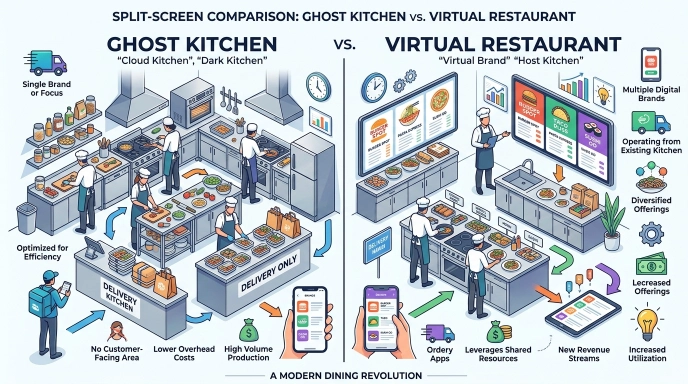
Many people use the terms ghost kitchen and virtual restaurant interchangeably, but they are not exactly the same thing. Understanding the difference is important if you’re researching delivery-only restaurant models or planning to launch an online food business.
Key Differences
A ghost kitchen refers to the physical kitchen facility where food is prepared exclusively for delivery or takeout orders.
A virtual restaurant, on the other hand, is the restaurant brand that customers see online.
In simple terms:
- Ghost Kitchen = The Kitchen Infrastructure
- Virtual Restaurant = The Customer-Facing Brand
For example, a single ghost kitchen may operate three virtual restaurant brands at the same time:
- Burger Brand
- Pizza Brand
- Wing Brand
Customers ordering through delivery apps may believe they are ordering from three separate restaurants, even though all meals are prepared in the same kitchen.
| Feature | Ghost Kitchen | Virtual Restaurant |
| Physical Kitchen Space | Yes | Not Necessarily |
| Customer-Facing Brand | No | Yes |
| Food Preparation Location | Yes | Uses Existing Kitchen |
| Multiple Brands Possible | Yes | Yes |
| Delivery-Focused | Yes | Yes |
Which Business Model Is Better?
Neither model is inherently better because they serve different purposes.
A ghost kitchen is ideal for entrepreneurs who need a dedicated delivery-focused kitchen facility.
A virtual restaurant is often better for existing restaurant owners who want to launch additional food concepts without opening new locations.
For example, a pizza restaurant could create a separate virtual chicken wing brand using its existing kitchen. This allows the business to reach new customers without investing in another restaurant.
For startups entering the food delivery market, ghost kitchens often provide more flexibility because they are designed specifically for delivery operations.
Key Takeaway
A ghost kitchen is the operational facility where food is prepared, while a virtual restaurant is the digital restaurant brand customers interact with online. Many successful food businesses use both models together.
Ghost Kitchen vs Cloud Kitchen vs Dark Kitchen
If you’ve been researching delivery-only restaurants, you’ve probably encountered terms like cloud kitchen, dark kitchen, and ghost kitchen.
This often creates confusion because these terms are frequently used interchangeably throughout the restaurant industry.
Are They the Same Thing?
In most cases, yes.
Ghost kitchen, cloud kitchen, and dark kitchen generally describe a commercial kitchen that prepares food primarily for delivery orders rather than dine-in customers.
The terminology often depends on the country, industry publication, or company using the term.
Common Industry Terminology
| Term | Meaning |
| Ghost Kitchen | Delivery-only kitchen operation |
| Cloud Kitchen | Technology-driven delivery kitchen |
| Dark Kitchen | Kitchen closed to public dining |
| Virtual Kitchen | Delivery-focused food production facility |
| Delivery-Only Restaurant | Restaurant serving online orders only |
Although these terms often describe similar concepts, subtle differences sometimes exist.
For example, some operators use “cloud kitchen” when emphasizing technology, software integration, and digital ordering systems.
Others use “dark kitchen” to describe facilities that have no public-facing presence whatsoever.
However, for most consumers and restaurant owners, the terms refer to the same general business model.
Important Differences to Know
While the terms overlap, understanding their context can help avoid confusion.
Ghost Kitchen
- Most common term in North America
- Focuses on delivery-only operations
Cloud Kitchen
- Popular in technology and startup sectors
- Emphasizes digital infrastructure
Dark Kitchen
- Common in Europe and some international markets
- Highlights the absence of a storefront
Virtual Restaurant
- Refers to the brand rather than the kitchen itself
The distinction is small, but understanding it demonstrates a deeper knowledge of the food delivery ecosystem.
Key Takeaway
Most businesses use ghost kitchen, cloud kitchen, and dark kitchen interchangeably. The core concept remains the same: preparing food for online orders without operating a traditional dine-in restaurant.
Types of Ghost Kitchens
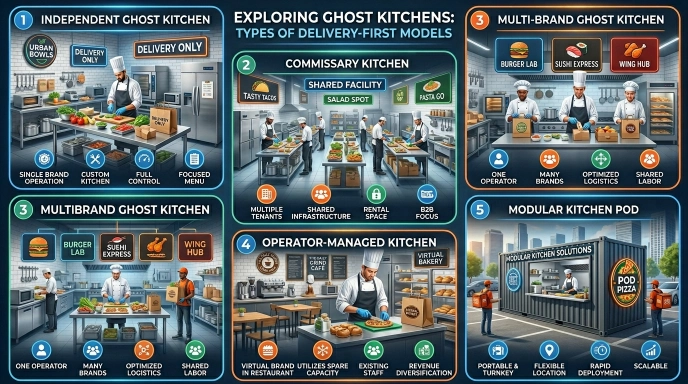
Not all ghost kitchens operate in the same way. Over the years, several different business models have emerged to meet the needs of restaurant owners, food entrepreneurs, and delivery-focused brands.
Understanding the various types of ghost kitchens can help determine which model best fits a specific business strategy.
Independent Ghost Kitchens
An independent ghost kitchen is a standalone delivery-only restaurant operated by a single business.
The owner rents or owns the kitchen space and manages all operations independently.
This model provides maximum control over:
- Branding
- Menu development
- Pricing
- Marketing
- Customer experience
Many food startups begin with this approach because it allows them to build a unique brand without the costs of a traditional restaurant.
Shared Commissary Kitchens
Commissary kitchens are shared commercial kitchen facilities rented by multiple food businesses.
Instead of building a kitchen from scratch, operators rent kitchen space based on their needs.
This option is popular among:
- Food trucks
- Caterers
- Startup restaurant brands
- Meal prep companies
Shared commissary kitchens offer lower startup costs while providing access to professional-grade equipment.
Multi-Brand Ghost Kitchens
A multi-brand ghost kitchen operates several restaurant concepts from a single kitchen location.
For example, one kitchen may simultaneously run:
- Burger Brand
- Taco Brand
- Pizza Brand
- Dessert Brand
Each brand appears separately on delivery apps, allowing operators to capture multiple customer segments without opening additional locations.
This model is increasingly popular because it maximizes kitchen utilization and increases revenue opportunities.
Operator-Managed Ghost Kitchens
In this model, a third-party company provides the kitchen facility, technology infrastructure, maintenance, and operational support.
Restaurant owners simply focus on food preparation while the facility operator manages:
- Property maintenance
- Shared services
- Technology systems
- Delivery logistics support
This approach reduces operational complexity for food entrepreneurs.
Virtual Restaurant Brands
Virtual restaurant brands are delivery-only brands that operate from existing restaurant kitchens.
Instead of opening a new kitchen, an established restaurant launches additional brands using its current equipment and staff.
For example:
A sandwich shop may create:
- A wing brand
- A burger brand
- A late-night snack brand
All three brands can operate from the same kitchen while targeting different customer audiences.
Kitchen Pod Models
Kitchen pods are compact, modular kitchen units designed specifically for food delivery operations.
These units are often built from shipping containers or prefabricated structures.
Benefits include:
- Lower construction costs
- Faster setup times
- Flexible locations
- Smaller footprint
Kitchen pods are particularly attractive for testing new markets before investing in larger facilities.
Which Type of Ghost Kitchen Is Best?
The best model depends on business goals, budget, and growth plans.
- New entrepreneurs often prefer commissary kitchens.
- Established restaurants frequently launch virtual restaurant brands.
- Growing operators may benefit from multi-brand kitchens.
- Scalable delivery businesses often choose dedicated ghost kitchen facilities.
Key Takeaway
Ghost kitchens come in several forms, including independent kitchens, shared commissary spaces, virtual restaurant brands, multi-brand operations, and kitchen pods. Each model offers different advantages depending on a business’s resources, objectives, and delivery strategy.
The History and Evolution of Ghost Kitchens
Although ghost kitchens may seem like a recent innovation, their roots can be traced back to the growing demand for food delivery services. As technology transformed consumer behavior, restaurants began searching for more efficient ways to serve customers beyond traditional dining rooms.
The concept gained momentum during the mid-2010s when food delivery apps made online ordering more convenient than ever before. Companies realized they could reduce overhead costs by eliminating dining areas and focusing entirely on food preparation and delivery.
The COVID-19 pandemic further accelerated the adoption of ghost kitchens. With dining restrictions affecting restaurants worldwide, many operators turned to delivery-only models to continue serving customers and generating revenue.
Today, ghost kitchens have evolved into a multi-billion-dollar segment of the food service industry. They are used by independent entrepreneurs, national restaurant chains, franchise operators, and even celebrity-backed food brands.
Key Milestones in the Evolution of Ghost Kitchens
- Growth of online food ordering platforms
- Expansion of third-party delivery services
- Rising commercial real estate costs
- Increased demand for convenience
- Pandemic-driven shift toward delivery
- Development of multi-brand kitchen operations
- Advances in restaurant technology and automation
Key Takeaway
Ghost kitchens emerged as a response to changing consumer habits and technological innovation. Their growth reflects the increasing importance of convenience, delivery efficiency, and digital commerce in the restaurant industry.
Why Ghost Kitchens Became So Popular
The rapid growth of ghost kitchens is not accidental. Several powerful economic and consumer trends have made this business model attractive to restaurant owners and food entrepreneurs.
Growth of Food Delivery Apps
Food delivery apps fundamentally changed how people order meals.
Platforms such as Uber Eats, DoorDash, and Grubhub allow customers to browse restaurants, compare menus, and place orders within minutes. This convenience has fueled tremendous growth in online food delivery.
As more consumers began ordering food digitally, restaurants needed a model designed specifically for delivery. Ghost kitchens emerged as the perfect solution.
Instead of investing heavily in physical locations, operators could focus on meeting delivery demand directly.
Lower Startup Costs
Opening a traditional restaurant often requires significant capital investment.
Business owners typically need to pay for:
- Dining room furniture
- Interior design
- Customer seating areas
- Prime retail locations
- Front-of-house staff
Ghost kitchens eliminate many of these expenses.
Without a dining room or storefront, entrepreneurs can launch food concepts with far lower startup costs while still reaching customers through online platforms.
Rising Commercial Rent Costs
Commercial real estate continues to become more expensive in many cities.
Traditional restaurants often depend on highly visible locations with significant foot traffic. These premium locations typically come with high rental costs and long-term lease commitments.
Ghost kitchens operate differently.
Because customers never visit the kitchen, operators can locate facilities in lower-cost areas while still serving large delivery zones.
This flexibility makes the business model financially attractive.
Consumer Preference for Convenience
Modern consumers increasingly prioritize convenience.
Many people prefer:
- Mobile ordering
- Contactless delivery
- Fast service
- Flexible meal options
Ghost kitchens are designed specifically to support these preferences.
Customers can browse menus, place orders, track deliveries, and receive meals without leaving their homes.
As convenience continues to influence purchasing behavior, ghost kitchens remain well-positioned for long-term growth.
Key Takeaway
Ghost kitchens became popular because they align perfectly with modern consumer expectations while helping restaurant operators reduce costs and improve operational efficiency.
Benefits of Ghost Kitchens
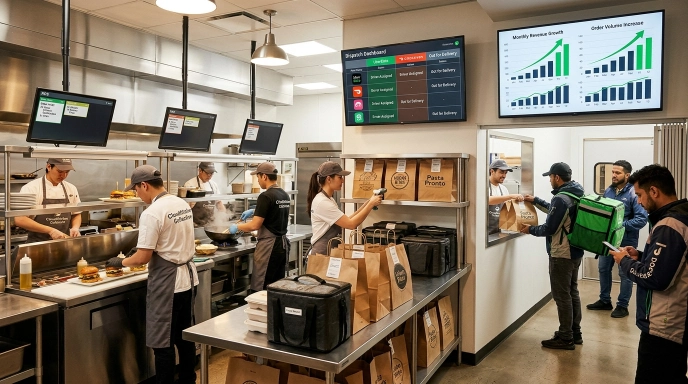
Ghost kitchens offer several advantages compared to traditional restaurant models. These benefits have contributed significantly to their growing popularity among both startups and established restaurant brands.
Lower Overhead Expenses
One of the biggest advantages of ghost kitchens is cost reduction.
Operators typically spend less money on:
- Rent
- Utilities
- Dining room maintenance
- Front-of-house staffing
- Interior design
This lower cost structure allows businesses to allocate more resources toward food quality, marketing, and customer acquisition.
Faster Market Expansion
Expanding a traditional restaurant often requires major investments and lengthy construction timelines.
Ghost kitchens allow businesses to enter new markets much faster.
Rather than opening full-service locations, brands can establish delivery-focused operations and test demand before committing to larger investments.
Multiple Brands From One Kitchen
A single ghost kitchen can operate multiple virtual restaurant brands simultaneously.
For example, one facility might prepare food for:
- A burger brand
- A pizza brand
- A healthy bowl concept
- A dessert-focused menu
This approach maximizes kitchen utilization and creates multiple revenue streams from the same location.
Easier Menu Testing
Traditional restaurants often face challenges when introducing new menu items.
Ghost kitchens provide greater flexibility.
Operators can quickly test:
- New recipes
- Seasonal offerings
- Regional food trends
- Niche concepts
Performance data from delivery platforms helps businesses identify successful products and refine their menus.
Delivery-Focused Operations
Unlike traditional restaurants that must balance dine-in and delivery customers, ghost kitchens focus exclusively on delivery.
This specialization can improve:
- Order accuracy
- Kitchen efficiency
- Preparation times
- Delivery coordination
As a result, customers often receive a more consistent delivery experience.
Better Profit Potential
When managed effectively, ghost kitchens can achieve attractive profit margins due to their lower operating expenses.
Businesses benefit from:
- Reduced overhead
- Streamlined staffing
- Optimized kitchen workflows
- Increased operational flexibility
However, profitability still depends on factors such as menu pricing, delivery fees, food costs, and customer demand.
Key Takeaway
Ghost kitchens provide restaurant operators with a flexible, scalable, and cost-efficient way to participate in the rapidly growing food delivery market.
Challenges and Drawbacks of Ghost Kitchens
Despite their advantages, ghost kitchens also face unique challenges that entrepreneurs should carefully evaluate before launching a delivery-only business.
Dependence on Delivery Apps
Many ghost kitchens rely heavily on third-party delivery platforms for customer acquisition.
This creates several risks:
- Commission fees
- Platform policy changes
- Increased competition
- Reduced control over customer relationships
Overreliance on a single platform can impact long-term profitability.
Limited Brand Visibility
Traditional restaurants benefit from physical visibility and foot traffic.
Ghost kitchens do not.
Without a storefront, businesses must rely on:
- Digital marketing
- Search visibility
- Social media promotion
- Delivery platform rankings
Building brand awareness often requires ongoing marketing investment.
High Competition
The low barrier to entry has encouraged many entrepreneurs to enter the delivery-only restaurant market.
As a result, competition on food delivery apps can be intense.
Businesses must differentiate themselves through:
- Food quality
- Branding
- Pricing
- Customer experience
Standing out in crowded marketplaces can be challenging.
Delivery Quality Control Issues
Even if a restaurant prepares excellent food, the delivery experience is not always under its control.
Factors such as:
- Traffic delays
- Driver availability
- Packaging failures
- Temperature loss
can negatively impact customer satisfaction.
Maintaining food quality during transportation remains a critical challenge.
Customer Trust Concerns
Some customers feel hesitant about ordering from brands they cannot physically visit.
Questions regarding:
- Food safety
- Business legitimacy
- Quality standards
may influence purchasing decisions.
Building trust requires transparency, positive reviews, strong branding, and consistent service quality.
Key Takeaway
Ghost kitchens offer significant opportunities, but success requires overcoming challenges related to delivery dependence, competition, visibility, and customer trust.
Are Ghost Kitchens Profitable?
Yes, ghost kitchens can be highly profitable when managed correctly. Their biggest advantage is a lower cost structure compared to traditional restaurants. Without the expenses associated with dining rooms, front-of-house staff, premium retail locations, and large facilities, operators can often achieve healthier profit margins.
However, profitability is not guaranteed.
Like any restaurant business, success depends on factors such as food quality, menu pricing, delivery demand, customer acquisition costs, operational efficiency, and competition within the local market.
A ghost kitchen that relies on popular delivery platforms, maintains strong customer ratings, and controls food costs effectively can generate substantial revenue while operating with fewer overhead expenses than a conventional restaurant.
Why Ghost Kitchens Can Be Profitable
Several factors contribute to the earning potential of delivery-only restaurants:
- Lower startup costs
- Reduced labor expenses
- Smaller kitchen footprints
- Ability to launch multiple brands
- Faster expansion into new markets
- Greater operational efficiency
- Strong demand for food delivery
These advantages allow operators to focus resources on growth and customer acquisition rather than maintaining expensive physical locations.
Average Revenue Potential
Revenue varies significantly depending on location, cuisine type, pricing strategy, and order volume.
A small independent ghost kitchen may generate a few thousand dollars per month, while larger multi-brand operations can generate hundreds of thousands of dollars in monthly sales.
Common revenue drivers include:
- Number of daily orders
- Average order value
- Delivery radius
- Brand visibility
- Repeat customers
- Customer reviews
- Menu optimization
Businesses that operate multiple virtual brands from a single kitchen often increase revenue potential by targeting different customer segments simultaneously.
For example, one kitchen may generate sales from:
- A burger brand during lunch
- A pizza brand during dinner
- A dessert brand during late-night hours
This strategy maximizes kitchen utilization throughout the day.
Typical Profit Margins
Profit margins vary widely across the restaurant industry.
Traditional restaurants often operate with relatively thin margins due to rent, staffing, utilities, and dining room expenses.
Ghost kitchens can potentially achieve stronger margins because they eliminate many of these costs.
Typical profit margins often depend on:
- Food costs
- Delivery commissions
- Labor expenses
- Rent
- Marketing costs
- Packaging expenses
Operators that successfully control costs and generate repeat business generally experience the strongest financial performance.
Factors That Impact Profitability
Several factors directly influence whether a ghost kitchen succeeds financially.
Menu Design
Menu items should be profitable, easy to prepare, and capable of maintaining quality during delivery.
Foods that travel poorly can lead to negative reviews and reduced customer retention.
Delivery Platform Fees
Third-party delivery platforms often charge commission fees.
Businesses must price menu items strategically to protect margins while remaining competitive.
Customer Reviews
Online reviews heavily influence purchasing decisions.
Higher ratings often lead to:
- Increased visibility
- More orders
- Better customer trust
- Higher conversion rates
Operational Efficiency
Fast preparation times and streamlined workflows improve productivity and reduce labor costs.
Efficient operations can significantly improve profitability.
Marketing Strategy
Even the best food concept may struggle without visibility.
Successful operators invest in:
- Local SEO
- Delivery app optimization
- Social media marketing
- Customer retention programs
Key Takeaway
Ghost kitchens can be profitable because they operate with lower overhead costs and greater flexibility than traditional restaurants. However, profitability ultimately depends on execution, customer demand, operational efficiency, and effective cost management.
How Much Does It Cost to Start a Ghost Kitchen?
One reason ghost kitchens have become so popular is their relatively low startup cost compared to traditional restaurants.
Opening a full-service restaurant often requires a substantial investment in property, renovations, furniture, staffing, and equipment. Ghost kitchens eliminate many of these expenses, making entry into the food service industry more accessible.
The total cost of starting a ghost kitchen depends on:
- Location
- Kitchen type
- Equipment requirements
- Licensing needs
- Technology stack
- Marketing budget
While costs vary, most ghost kitchens require significantly less capital than a traditional restaurant.
Equipment Costs
Every ghost kitchen requires commercial kitchen equipment.
Common equipment includes:
- Refrigerators
- Freezers
- Ovens
- Grills
- Fryers
- Prep tables
- Food storage systems
- Packaging stations
Equipment costs depend heavily on menu complexity.
A simple sandwich concept may require minimal equipment, while a full-service cooking operation may need a much larger investment.
Many operators reduce startup expenses by renting shared kitchen space that already includes essential equipment.
Licensing and Permits
Like traditional restaurants, ghost kitchens must comply with local regulations.
Common requirements include:
- Business licenses
- Food service permits
- Health department approvals
- Food handler certifications
- Fire safety inspections
Permit costs vary by city, state, and country.
Failure to obtain proper licenses can lead to fines or business closure, making compliance an essential part of the startup process.
Commercial Kitchen Rental Costs
Kitchen rental is often one of the largest recurring expenses.
Operators generally choose between:
- Shared commissary kitchens
- Dedicated ghost kitchen facilities
- Private commercial kitchen spaces
Rental costs depend on:
- Market demand
- Facility size
- Equipment availability
- Operating hours
- Geographic location
Urban markets typically command higher rental rates than smaller cities.
Technology and Delivery Platform Fees
Modern ghost kitchens depend heavily on technology.
Common expenses include:
- Online ordering systems
- Point-of-sale software
- Order management platforms
- Delivery integrations
- Website development
- Payment processing tools
Businesses that use third-party delivery apps must also account for commission fees and service charges.
Although these costs can reduce margins, delivery platforms often provide access to large customer bases that would otherwise be difficult to reach.
Estimated Startup Cost Range
Depending on the business model, startup costs can range from a few thousand dollars for a small commissary kitchen operation to significantly larger investments for dedicated multi-brand facilities.
Factors affecting startup costs include:
- Business scale
- Location
- Equipment needs
- Staffing requirements
- Marketing investment
Entrepreneurs should develop a detailed financial plan before launching to ensure adequate funding.
Key Takeaway
Starting a ghost kitchen generally costs less than opening a traditional restaurant because operators avoid many of the expenses associated with dining rooms and customer-facing facilities. However, careful budgeting is still essential for long-term success.
How to Start a Ghost Kitchen Business
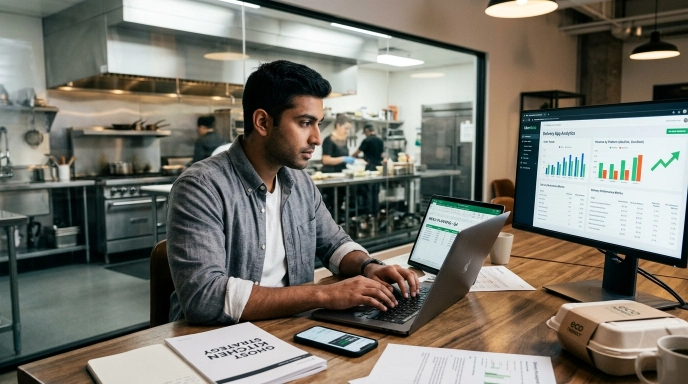
Starting a ghost kitchen business requires careful planning, but it is often faster and less expensive than launching a traditional restaurant. The delivery-only model allows entrepreneurs to enter the food service industry with lower overhead costs while reaching customers through online ordering platforms.
Whether you’re a first-time food entrepreneur or an experienced restaurant owner, following a structured process can significantly improve your chances of success.
Choose a Food Concept
Every successful ghost kitchen starts with a strong food concept.
Before investing money into equipment, kitchen space, or marketing, identify what type of food you want to sell and who your target customers will be.
Consider:
- Market demand
- Local competition
- Delivery-friendly menu items
- Average order value
- Customer preferences
The most successful ghost kitchen concepts often focus on foods that travel well and maintain quality during delivery.
Examples include:
- Burgers
- Pizza
- Wings
- Rice bowls
- Sandwiches
- Mexican food
- Asian cuisine
- Desserts
A focused concept helps create a stronger brand and simplifies operations.
Create a Business Plan
A business plan serves as the foundation of your ghost kitchen.
It should outline:
- Business goals
- Target audience
- Startup costs
- Revenue projections
- Marketing strategy
- Competitive analysis
- Operational plan
A well-developed business plan helps secure funding, manage expenses, and establish realistic growth expectations.
Important questions to answer include:
- How many orders are needed to break even?
- What are the expected food costs?
- Which delivery platforms will be used?
- How will customers discover the brand?
Planning reduces risk and improves decision-making.
Find a Kitchen Space
The next step is securing a licensed commercial kitchen.
Most ghost kitchen operators choose one of the following options:
Shared Commissary Kitchen
A shared facility rented by multiple food businesses.
Advantages:
- Lower startup costs
- Flexible rental agreements
- Access to commercial equipment
Dedicated Ghost Kitchen Facility
A delivery-focused kitchen designed specifically for online food brands.
Advantages:
- Professional infrastructure
- Delivery optimization
- Scalability
Private Commercial Kitchen
A standalone kitchen controlled entirely by the business.
Advantages:
- Full operational control
- Greater customization
- Long-term growth potential
The best choice depends on budget, business size, and expansion goals.
Obtain Licenses and Permits
Ghost kitchens must comply with the same food safety regulations that apply to traditional restaurants.
Common requirements include:
- Business registration
- Food service license
- Health department permit
- Food handler certification
- Fire safety approval
- Sales tax registration
Regulations vary by jurisdiction, so it’s important to consult local authorities before launching operations.
Failure to obtain proper permits can result in penalties, closures, or legal complications.
Set Up Online Ordering Systems
Technology is the backbone of a ghost kitchen business.
Customers need a simple way to browse menus, place orders, and make payments online.
Many operators use:
- Restaurant websites
- Mobile ordering platforms
- Point-of-sale systems
- Order management software
- Delivery integration tools
Modern systems often combine orders from multiple delivery apps into one dashboard, making operations easier to manage.
Key features to prioritize include:
- Real-time order tracking
- Inventory management
- Payment processing
- Customer analytics
- Reporting tools
Efficient technology improves both customer experience and operational efficiency.
Partner With Delivery Apps
Delivery platforms provide access to large customer audiences and can accelerate growth during the early stages of a business.
Popular platforms include:
- Uber Eats
- DoorDash
- Grubhub
- Deliveroo
- Just Eat
When evaluating delivery partners, consider:
- Commission rates
- Market reach
- Delivery coverage
- Customer base
- Platform reputation
Many successful ghost kitchens use multiple delivery apps to maximize visibility and increase order volume.
Diversifying delivery channels also reduces dependence on a single platform.
Launch and Market Your Brand
A ghost kitchen without marketing is unlikely to succeed, regardless of food quality.
Since there is no physical storefront generating foot traffic, customer acquisition must happen digitally.
Effective marketing strategies include:
Local SEO
Optimize your website and online profiles for location-based searches.
Examples:
- Best burgers near me
- Late-night pizza delivery
- Delivery-only restaurant in [city]
Delivery App Optimization
Improve visibility through:
- High-quality food photography
- Compelling menu descriptions
- Positive customer reviews
- Competitive pricing
Social Media Marketing
Use platforms such as:
- TikTok
- YouTube Shorts
Visual content can significantly increase brand awareness and engagement.
Customer Retention
Repeat customers are often more profitable than new customers.
Encourage loyalty through:
- Promotions
- Email marketing
- Loyalty programs
- Personalized offers
Strong customer retention improves long-term profitability.
Common Mistakes to Avoid
Many ghost kitchen startups struggle because they focus solely on food while ignoring operational and marketing challenges.
Avoid these common mistakes:
- Launching without market research
- Offering an overly complex menu
- Ignoring food delivery quality
- Underestimating delivery fees
- Relying on a single delivery platform
- Neglecting online marketing
- Failing to track customer feedback
Learning from these mistakes can save both time and money.
Key Takeaway
Starting a ghost kitchen business involves selecting a profitable food concept, creating a solid business plan, securing a licensed kitchen, obtaining permits, implementing technology systems, partnering with delivery platforms, and building a strong digital marketing strategy. Businesses that focus on efficiency, customer experience, and brand visibility are often best positioned for long-term success.
Are Ghost Kitchens Legal?
Yes, ghost kitchens are legal in most countries and regions, provided they comply with the same food safety, licensing, and health regulations that apply to traditional restaurants.
A common misconception is that ghost kitchens operate in a legal gray area because customers never visit the facility. In reality, most jurisdictions treat ghost kitchens as food service businesses and require them to meet strict regulatory standards.
Whether a business operates from a shared commissary kitchen, dedicated ghost kitchen facility, or private commercial kitchen, it must typically follow local laws related to food preparation, sanitation, employee safety, and consumer protection.
The exact requirements vary by location, but the core principle remains the same: if a business prepares and sells food to the public, it must comply with food service regulations.
Why People Question Their Legality
Ghost kitchens often create confusion because customers cannot physically visit the location.
Many consumers discover brands exclusively through food delivery apps and may wonder:
- Is this a real restaurant?
- Is the food prepared safely?
- Has the kitchen been inspected?
- Is the business licensed?
The answer depends on the operator, but legitimate ghost kitchens follow the same legal requirements as other food businesses.
Key Takeaway
Ghost kitchens are legal when they operate under proper licenses, permits, and food safety regulations. They are not exempt from health inspections or restaurant compliance requirements simply because they do not have dining rooms.
Food Safety Requirements
Food safety is one of the most important responsibilities of any ghost kitchen.
Because customers cannot physically inspect the facility, maintaining high food safety standards becomes even more critical for building trust and protecting public health.
Most jurisdictions require ghost kitchens to follow established food safety practices, including:
- Proper food storage
- Temperature control
- Cross-contamination prevention
- Employee hygiene standards
- Safe food handling procedures
- Cleaning and sanitation protocols
Failure to comply with food safety regulations can lead to:
- Fines
- License suspension
- Negative reviews
- Legal liability
- Business closure
Common Food Safety Practices
Successful ghost kitchen operators typically implement:
Temperature Monitoring
Hot foods must remain hot, and cold foods must remain cold throughout storage and preparation.
Proper temperature control helps prevent foodborne illnesses.
Employee Training
Kitchen staff should understand:
- Food handling procedures
- Personal hygiene requirements
- Cleaning standards
- Allergen awareness
Well-trained employees reduce operational risks.
Food Storage Systems
Ingredients should be stored correctly and clearly labeled.
Proper inventory management helps maintain food quality and minimize waste.
Sanitation Procedures
Regular cleaning schedules help ensure a safe and compliant kitchen environment.
This includes:
- Work surfaces
- Equipment
- Food preparation stations
- Storage areas
Key Takeaway
Food safety is not optional for ghost kitchens. Strong sanitation practices, employee training, and regulatory compliance are essential for protecting customers and maintaining business credibility.
Licensing Regulations
Before serving customers, ghost kitchens typically need several licenses and permits depending on local regulations.
Although requirements vary by city, state, and country, most operators must obtain approval from multiple agencies before launching operations.
Common Licenses and Permits
Business License
Allows the company to legally operate within its jurisdiction.
Food Service Permit
Authorizes the preparation and sale of food to the public.
Health Department Approval
Verifies compliance with local food safety standards.
Sales Tax Registration
Required in many jurisdictions for collecting and remitting taxes.
Fire Safety Permit
Confirms that the facility meets fire prevention and emergency safety requirements.
Food Handler Certifications
Some regions require employees to complete approved food safety training programs.
Why Compliance Matters
Operating without required licenses can lead to:
- Financial penalties
- Forced shutdowns
- Legal disputes
- Loss of customer trust
Obtaining the proper permits before launch helps create a stable foundation for long-term growth.
Key Takeaway
Ghost kitchens generally require many of the same licenses and permits as traditional restaurants. Entrepreneurs should verify local requirements before opening a delivery-only food business.
Health Inspection Requirements
Ghost kitchens are typically subject to health inspections just like traditional restaurants.
Health inspectors evaluate whether a facility complies with food safety regulations and operational standards designed to protect consumers.
Inspections may occur:
- Before opening
- Periodically throughout operation
- Following customer complaints
- During permit renewals
What Inspectors Look For
Health inspections often evaluate:
Food Storage Practices
Inspectors check whether ingredients are stored safely and at appropriate temperatures.
Sanitation Standards
Cleanliness throughout the facility is closely reviewed.
This includes:
- Floors
- Equipment
- Food preparation surfaces
- Storage areas
Employee Hygiene
Staff members must follow proper hygiene procedures, including handwashing and safe food handling practices.
Pest Control Measures
Facilities must demonstrate effective pest prevention and management practices.
Equipment Maintenance
Kitchen equipment should be functioning correctly and maintained according to safety standards.
Building Customer Trust
Strong inspection records can help reassure customers that a ghost kitchen operates professionally and responsibly.
In an industry where customers rarely see the kitchen, compliance becomes an important trust signal.
Key Takeaway
Health inspections play a vital role in ensuring ghost kitchens meet food safety standards. Businesses that prioritize compliance and sanitation are better positioned to build long-term customer confidence.
Real Examples of Ghost Kitchens
One of the easiest ways to understand the ghost kitchen business model is by looking at real-world examples.
Today, ghost kitchens serve everyone from independent food entrepreneurs to major restaurant chains and global food brands.
Independent Delivery Brands
Many ghost kitchens are operated by small business owners who launch delivery-only restaurant concepts without opening a traditional storefront.
Examples include:
- Local burger brands
- Specialty wing concepts
- Healthy meal prep businesses
- Dessert delivery brands
- Late-night food concepts
These businesses often focus entirely on online ordering and delivery.
Because overhead costs are lower, entrepreneurs can test new ideas with less financial risk.
Restaurant-Owned Virtual Brands
Many established restaurants use ghost kitchen principles to launch additional brands from their existing kitchens.
For example:
A pizza restaurant might also launch:
- A wing brand
- A sandwich brand
- A dessert concept
Customers ordering through delivery apps may view these as separate restaurants, even though the food is prepared in the same kitchen.
This strategy helps maximize revenue without opening additional locations.
Multi-Brand Kitchen Operators
Some companies specialize in operating facilities that support multiple delivery-only brands.
These operators provide:
- Kitchen infrastructure
- Shared resources
- Technology platforms
- Delivery optimization tools
Restaurant owners can rent space and focus on food preparation while the facility operator manages much of the operational infrastructure.
This model has become increasingly popular in major metropolitan areas where delivery demand is high.
What These Examples Teach Us
Although ghost kitchens come in many forms, they all share several characteristics:
- Delivery-focused operations
- Digital-first customer acquisition
- Lower overhead costs
- Commercial kitchen facilities
- Emphasis on convenience
The specific business model may vary, but the underlying goal remains the same: serving customers efficiently through online ordering and food delivery.
Key Takeaway
Ghost kitchens are used by independent entrepreneurs, traditional restaurant operators, and large-scale kitchen providers alike. Their flexibility makes them one of the most adaptable business models in the modern food service industry.
How Ghost Kitchens Are Changing the Restaurant Industry
Ghost kitchens are reshaping the restaurant industry by challenging the traditional assumption that every successful restaurant needs a physical dining room.
For decades, restaurants relied heavily on location, foot traffic, and in-person dining experiences. Today, technology and consumer behavior have created new opportunities for businesses to reach customers without operating expensive storefronts.
As online food ordering continues to grow, ghost kitchens have become an increasingly important part of the modern restaurant ecosystem.
Expanding Access for Food Entrepreneurs
Historically, opening a restaurant required significant capital investment.
Entrepreneurs often needed to secure:
- Premium real estate
- Dining room furniture
- Large staffs
- Extensive renovations
Ghost kitchens reduce many of these barriers.
As a result, more entrepreneurs can enter the food service industry with lower startup costs and less financial risk.
This increased accessibility encourages innovation and competition.
Accelerating Restaurant Expansion
Ghost kitchens allow restaurant brands to expand into new markets faster than traditional restaurant models.
Instead of investing hundreds of thousands of dollars in a new location, businesses can launch delivery-only operations and test demand before making larger commitments.
This approach helps companies:
- Reduce risk
- Gather customer data
- Improve market selection
- Scale more efficiently
Many restaurant chains now use ghost kitchens as part of their growth strategy.
Driving Digital Transformation
Ghost kitchens are accelerating the restaurant industry’s shift toward digital operations.
Modern delivery-focused businesses rely heavily on:
- Online ordering platforms
- Mobile apps
- Customer analytics
- Delivery technology
- Automated workflows
This technology-driven approach enables restaurants to make faster, data-informed decisions.
Increasing Consumer Choice
Consumers now have access to more food options than ever before.
A single ghost kitchen facility may support multiple restaurant brands serving different cuisines and customer preferences.
This increased variety benefits customers while creating new revenue opportunities for operators.
Key Takeaway
Ghost kitchens are transforming the restaurant industry by lowering barriers to entry, accelerating expansion, increasing operational efficiency, and supporting the growing demand for digital food ordering.
The Future of Ghost Kitchens
The future of ghost kitchens appears closely tied to the continued growth of food delivery, restaurant technology, and changing consumer preferences.
While the industry will continue evolving, several trends are likely to shape its future.
Greater Technology Integration
Technology will become even more important in ghost kitchen operations.
Future innovations may include:
- Artificial intelligence
- Predictive demand forecasting
- Kitchen automation
- Smart inventory management
- Delivery route optimization
These tools can help businesses improve efficiency and reduce costs.
Increased Competition
As more entrepreneurs enter the market, competition will likely intensify.
Businesses that succeed will need to focus on:
- Food quality
- Brand differentiation
- Customer experience
- Operational excellence
Simply opening a ghost kitchen will no longer be enough to guarantee success.
Growth of Multi-Brand Operations
Many operators are expected to continue running multiple virtual restaurant brands from a single kitchen.
This strategy allows businesses to maximize kitchen capacity and serve multiple customer segments simultaneously.
The trend toward multi-brand operations is likely to remain strong.
Stronger Direct-to-Consumer Strategies
Many ghost kitchens are becoming less dependent on third-party delivery apps.
To improve margins and strengthen customer relationships, businesses are increasingly investing in:
- Direct online ordering
- Mobile apps
- Loyalty programs
- Email marketing
- Subscription models
This shift may help operators gain greater control over customer acquisition and retention.
Sustainability and Efficiency
Future ghost kitchens may place greater emphasis on:
- Sustainable packaging
- Waste reduction
- Energy efficiency
- Local sourcing
Consumers are becoming more conscious of environmental issues, creating incentives for businesses to adopt more sustainable practices.
Key Takeaway
The future of ghost kitchens will likely be defined by technology, operational efficiency, customer convenience, and increasingly sophisticated delivery-focused business models.
Frequently Asked Questions
What Is Another Name for a Ghost Kitchen?
Ghost kitchens are also known as cloud kitchens, dark kitchens, virtual kitchens, delivery-only kitchens, and virtual restaurants. While some industry professionals make slight distinctions between these terms, they generally refer to food businesses that primarily serve customers through online ordering and delivery services.
Do Ghost Kitchens Have Dining Rooms?
No. Most ghost kitchens do not have dining rooms, customer seating areas, or traditional storefronts. Their primary purpose is preparing food for delivery and takeout orders rather than serving dine-in customers.
Can Customers Pick Up Orders From Ghost Kitchens?
Some ghost kitchens allow customer pickup, while others focus exclusively on delivery. Policies vary depending on the operator, facility design, and local regulations.
Are Ghost Kitchens Worth Starting?
Ghost kitchens can be an attractive business opportunity for entrepreneurs seeking lower startup costs and greater operational flexibility. However, success depends on factors such as market demand, food quality, branding, marketing, and execution.
What Is the Difference Between a Ghost Kitchen and a Restaurant?
A traditional restaurant typically serves customers in a physical dining space, while a ghost kitchen focuses exclusively on preparing food for delivery and takeout orders. Ghost kitchens operate behind the scenes and rely heavily on online ordering platforms.
Can One Ghost Kitchen Operate Multiple Brands?
Yes. Many ghost kitchens operate multiple virtual restaurant brands from a single location. This strategy allows businesses to target different customer segments while maximizing kitchen utilization.
How Do Ghost Kitchens Make Money?
Ghost kitchens generate revenue through food sales. Customers place orders through delivery platforms or direct ordering channels, and the business earns income from each completed order. Profitability depends on factors such as food costs, delivery fees, marketing expenses, and operational efficiency.
What Are the Biggest Risks of Running a Ghost Kitchen?
Common risks include:
- Dependence on delivery platforms
- Intense competition
- Rising marketing costs
- Negative customer reviews
- Delivery quality issues
- Regulatory compliance requirements
Businesses that proactively manage these challenges are more likely to succeed.
Key Takeaways
- A ghost kitchen is a delivery-only restaurant that prepares food without a traditional dining room or storefront.
- Ghost kitchens are also called cloud kitchens, dark kitchens, and virtual kitchens.
- Customers place orders online through websites, mobile apps, and food delivery platforms.
- The business model reduces overhead costs by eliminating many expenses associated with traditional restaurants.
- Ghost kitchens can operate multiple virtual brands from a single commercial kitchen.
- Popular benefits include lower startup costs, faster expansion, greater flexibility, and delivery-focused operations.
- Common challenges include delivery platform dependence, increased competition, and limited physical visibility.
- Ghost kitchens must comply with food safety regulations, licensing requirements, and health inspections.
- Profitability depends on operational efficiency, customer demand, menu strategy, and effective marketing.
- As food delivery continues to grow, ghost kitchens are expected to remain an important part of the restaurant industry’s future.
Final Thoughts
Ghost kitchens have fundamentally changed how food businesses operate in the digital age. By combining commercial kitchen facilities, online ordering technology, and delivery-focused operations, they offer a flexible alternative to traditional restaurants.
For entrepreneurs, ghost kitchens provide an opportunity to enter the food service industry with lower upfront investment and greater scalability. For established restaurant brands, they offer a powerful way to expand into new markets and adapt to changing consumer preferences.
As technology continues to evolve and food delivery becomes increasingly integrated into everyday life, ghost kitchens are likely to play an even larger role in shaping the future of the restaurant industry.
